A calm, guided rhythm for your homeschool week.
![[background image] image of cozy reading nook (for an author & writer)](https://cdn.prod.website-files.com/69dbe348d0a29252603f7d2c/6a4c6482cb2a21ca76fe72fd_r4.png)
A Gentle Week, Made Simple
A calm rhythm designed to bring beauty, wonder, and meaningful work into your learning week.
This weekly rhythm is meant to give your family a gentle shape to the week without adding more to your plate.
This week includes three guided days. There is no need to complete everything. Use the full rhythm, or simply choose the parts that fit your family best. There is no pressure to do it all.
Follow the rhythm, not the clock.
Early July Weekly Rhythm
Day One
Today we look closely at one small summer thing.
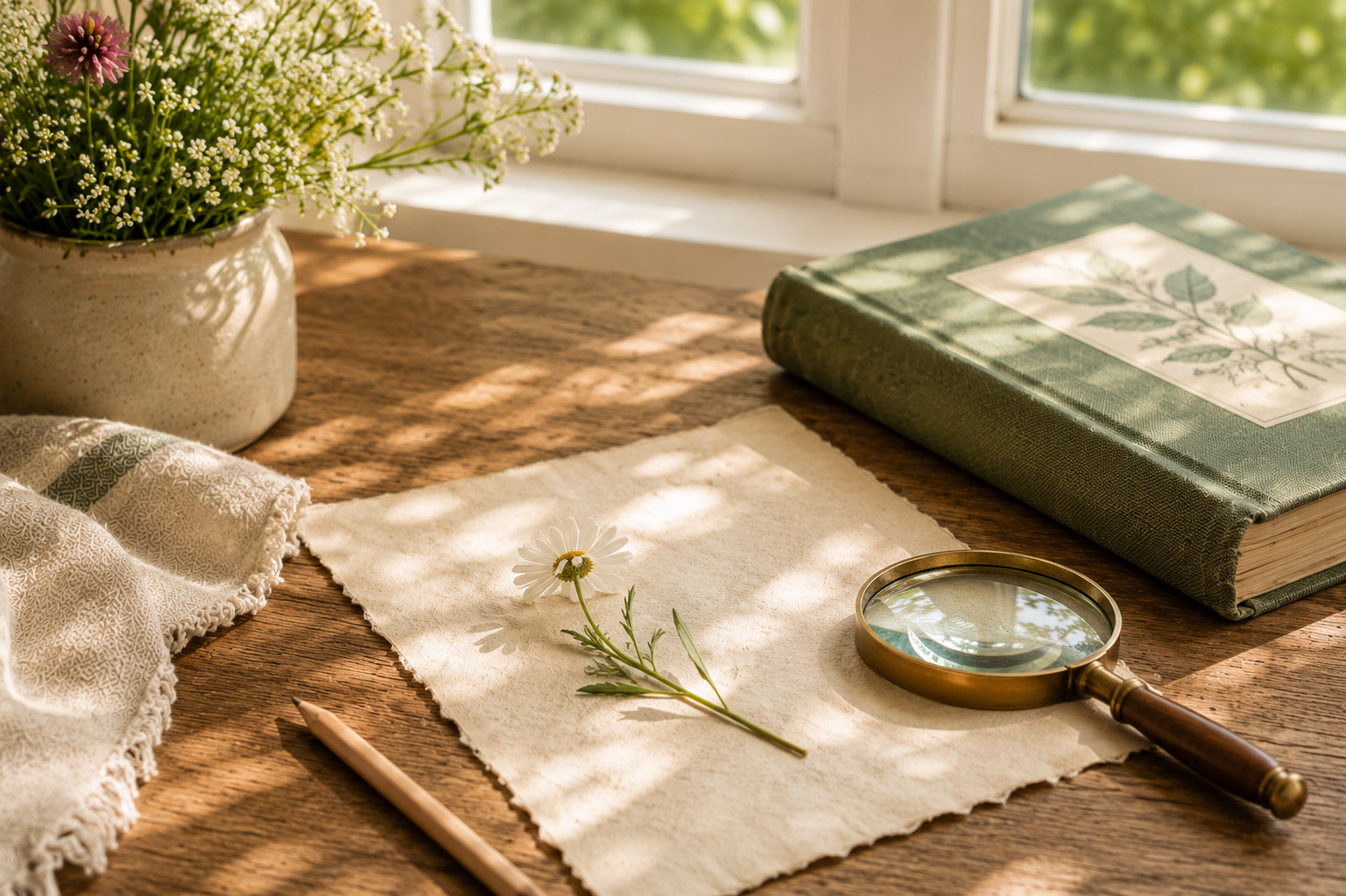
Morning Gathering
Let this gently open the day.
Begin near a window, table, or quiet outdoor spot.
Place one small seasonal object in the center: a leaf, flower, smooth stone, seed pod, piece of fruit, small shell, or cup of water.
Speak together:
Summer holds small things to see,
Leaf and flower, stone and tree.
Tiny lines and colors bright,
Waiting in the morning light.
We will pause and look with care,
Simple wonders everywhere.
Pause for a moment.
Then ask:
What is one small thing we can look at closely today?
A leaf. A flower. A stone. A piece of fruit. A shell. A tiny stick. A seed. A cup of water.
Anything is enough.
Core Experience
Look Closely at One Small Summer Thing
A simple way to notice details without turning them into a lesson.
You’ll need:
- One small summer object to look at closely
- A simple place to put it, such as a tray, cloth, bowl, or piece of paper
- Optional: a magnifying glass, if you have one
Choose one small thing to look at together.
It might be:
- A leaf
- A flower
- A smooth stone
- A small shell
- A seed pod
- A small stick
- A piece of fruit
Place the one thing on the tray, cloth, bowl, or paper.
Invite your child to look slowly.
You might wonder aloud:
What color do you see?
What shape is it?
Is it smooth, bumpy, soft, dry, shiny, or rough?
Do you see lines, spots, edges, or tiny marks?
What does it remind you of?
Let your child touch it gently.
They might turn it over.
They might hold it near the light.
They might smell it.
They might notice something you did not see.
There is no need to name every part.
There is no need to explain the science.
One close look is enough.
The looking, touching, wondering, and noticing are the work.
When interest fades, return the object, place it outside, or leave it nearby for a little while.
The experience is complete.
Meaningful Work
Care for Simple Tools
Invite your child into one small act of real work that helps care for the things your family uses.
Choose one:
- Put crayons or pencils in a cup
- Fold one cloth or napkin
- Carry a small tray carefully
- Place paper in a basket or drawer
- Wipe one small spot on the table
- Carry one cup to the sink
- Return one nature object outside
Choose just one small task.
Move slowly.
Let your child help in a real way.
There is no need to organize everything.
One small act of care is enough.
These small acts help children feel capable, included, and part of the family rhythm.
Outdoor Invitation
Notice One Small Thing Outside
Step outside together and slow down for a moment.
Look for one small summer thing to notice.
You might notice:
- A leaf on a branch
- A flower by the path
- A stone near your feet
- A stick in the grass
- A seed on the ground
- A bug moving nearby
- A place where water has dried
Walk slowly.
Choose one thing to notice without needing to pick it up.
You can ask:
What do you see?
Or:
What small thing should we look at?
There is no need to walk far.
There is no need to bring anything inside.
One small discovery outside is enough.
Quiet Work
Draw One Detail
Simple drawing, quiet attention, and gentle creativity.
You’ll need:
- Paper
- Crayons, colored pencils, or a pencil
Invite your child to draw one detail from what they noticed.
They might draw:
- A line on a leaf
- A dot on a flower
- The shape of a stone
- A small circle
- A color they saw
- A few simple marks
You can say:
Can you draw one small part of what we noticed?
It does not need to look like the real thing.
For younger children, simple marks are enough.
For older children, they may want to add more detail.
Sit nearby without directing the outcome.
When the page feels complete, set it aside.
The work is finished.
Small Reflection
Simple questions help children revisit and deepen their discoveries.
Later in the day, perhaps at lunch or bedtime, ask:
What did we look at closely today?
Or:
What tiny thing did you notice?
For older children:
What did you see after you looked for a little longer?
No formal answer is needed.
The question is enough.
Day Two
Today we gather a few simple things and notice how they are alike and different.
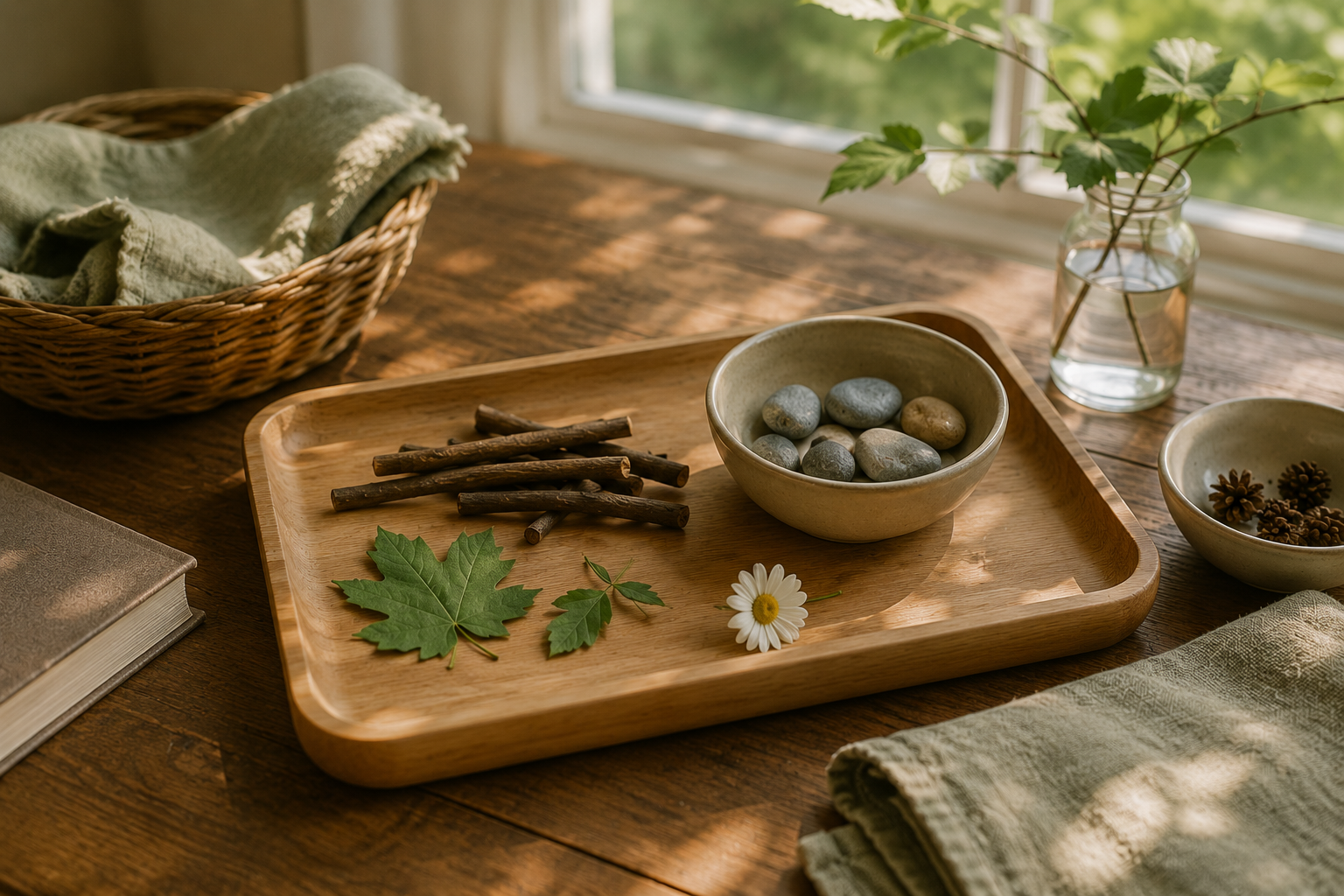
Morning Gathering
Begin near a window, table, or quiet outdoor spot.
Place one small tray, cloth, bowl, or basket in the center.
Add two or three simple objects if you have them nearby: a leaf, stone, flower, seed pod, spoon, wooden block, piece of fruit, or folded napkin.
Speak together:
Small things gathered, one by one,
Found in shade and found in sun.
Smooth and rough and big and small,
We can make a place for all.
Hands can carry, eyes can see,
Simple order, quietly.
Pause for a moment.
Then ask:
What could we gather and sort today?
Leaves. Stones. Flowers. Sticks. Spoons. Blocks. Fruit. Napkins. Anything simple nearby.
Anything is enough.
Core Experience
Make a Small Summer Sorting Tray
A simple hands-on project for noticing, sorting, and caring for materials.
You'll need:
- One simple sorting surface, such as a tray, cloth, plate, basket, or shallow bowl
- Four to six simple objects to sort
- Optional: two small bowls, napkins, or pieces of paper to help make groups
The tray, cloth, plate, basket, or bowl gives your child one clear place to work.
The small bowls, napkins, or pieces of paper are only helpful if your child wants separate places for groups.
If you do not have them, your child can simply make small piles on the tray or cloth.
Choose four to six simple objects.
They can come from outside, the kitchen, a shelf, or a simple basket of materials.
They do not need to match.
You might use:
- A few leaves
- A few stones
- A flower
- A few sticks
- Seed pods
- Spoons
- Wooden blocks
- Pieces of fruit
- Small cloths or napkins
Place the objects on the tray or cloth.
Pause together and look at what you gathered.
You might say:
Let’s see what we have.
Some things are big.
Some things are small.
Some things are smooth.
Some things are rough.
Invite your child to move the objects into small groups.
You might say:
Can you put two things together that feel the same?
Or:
Can you find two things that look different?
Your child might sort by:
- Big and small
- Smooth and rough
- Light and dark
- Green and brown
- Soft and hard
- Round and long
- Things from outside and things from inside
Let your child sort in their own way.
Maybe all the green things go together.
Maybe the soft things go together.
Maybe the favorite things go in one bowl.
Maybe your child simply lines them up.
There is no need to sort correctly.
There is no need to make categories ahead of time.
There is no need to use every object.
The gathering, placing, comparing, and arranging are the work.
When interest fades, return the objects or leave the tray nearby for a little while.
The experience is complete.
Meaningful Work
Return and Care
Invite your child into one small act of real work connected to caring for materials and restoring order.
Choose one:
- Carry the tray carefully
- Return stones, sticks, or leaves outside
- Put spoons back in the drawer
- Fold the cloth or napkin
- Wipe the tray or table
- Place flowers in a small cup of water
- Put bowls back on a shelf
Let your child help with the ending.
Move slowly.
One small act of care is enough.
These small acts help children feel capable and trusted.
Outdoor Invitation
Gather a Few Summer Things
Step outside together and gather a few simple things, if it fits your day.
You might gather:
- Three leaves
- Two stones
- A few small sticks
- A flower that has already fallen
- A seed pod
- A blade of grass
- A tiny piece of bark
Keep the gathering small.
You can say:
Let’s find three small things.
Or:
Let’s find one smooth thing and one rough thing.
Look together.
Carry them carefully.
When you are finished, return them outside or place them on a porch, step, or table for a little while.
There is no need to collect a lot.
A few small things are enough.
Quiet Work
Summer Sorting Marks
Simple marks, early noticing, and gentle creativity.
You’ll need:
- Paper
- Crayons, colored pencils, or a pencil
Invite your child to make a simple sorting page.
They might make:
- Big marks and small marks
- Smooth lines and bumpy lines
- Green marks and brown marks
- Long lines and round shapes
- Two little groups on the page
- A few colors from the things they sorted
You can say:
Can you make one mark for something big and one mark for something small?
Or:
Can you make a smooth line and a bumpy line?
For younger children, any marks on the page are enough.
For older children, they may want to draw two groups or add simple labels.
There is no need to make a worksheet.
Let the page stay open and simple.
When the page feels complete, set it aside.
Small Reflection
Simple questions help children revisit and deepen their discoveries.
Later in the day, ask:
What did we gather today?
Or:
How did we sort our things?
For older children:
What was the same about two things we sorted?
No formal answer is needed.
The question is enough.
Day Three
Today we make a tiny book to remember what we noticed this week.
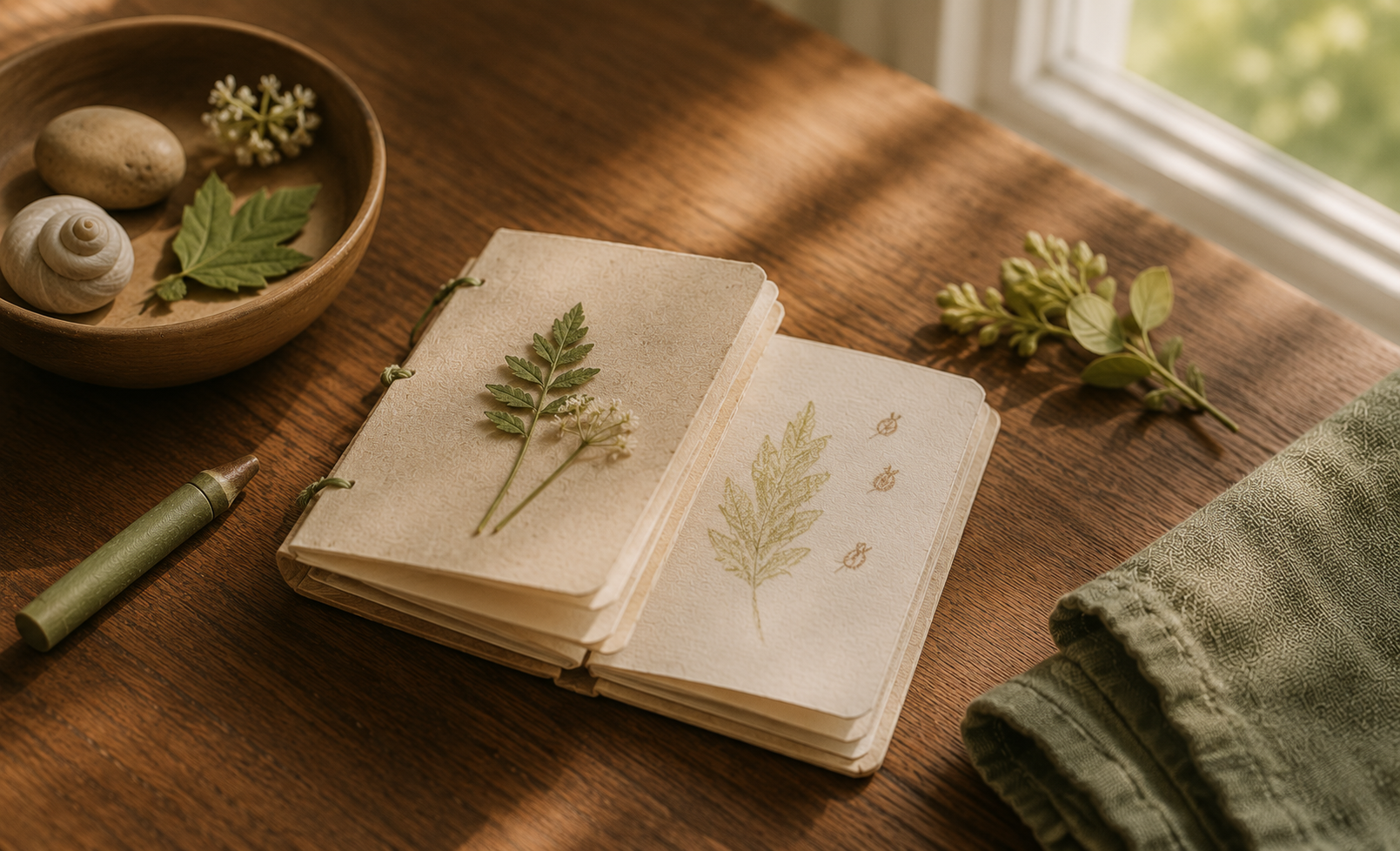
Morning Gathering
Begin near a window, table, or quiet outdoor spot.
Place one folded piece of paper, one crayon or pencil, and one small summer object in the center.
Speak together:
Little pages, folded small,
Hold the things we saw and found.
Leaf or flower, stone or sun,
A tiny book has just begun.
Page by page, we gently see,
Small discoveries stay with me.
Pause for a moment.
Then ask:
What is one small thing we remember from this week?
A leaf. A flower. A color. A sound. A stone. A tray. A quiet place. A small thing you noticed together.
Anything is enough.
Core Experience
Make a Tiny Summer Book
A simple project to gather the week’s small discoveries in one place.
You’ll need:
- Two or three pieces of paper
- Crayons, colored pencils, or a pencil
- Optional: a stapler, string, ribbon, or tape
- Optional: one small object to look at while you work
Fold two or three pieces of paper in half to make a tiny book.
If that feels like too much, fold one piece of paper in half.
That is enough.
Invite your child to help make a few simple pages.
You might make:
- One page for something you looked at closely
- One page for something you gathered or sorted
- One page for a summer color, sound, or place
You can say:
This page can be for something we saw.
This page can be for something we gathered.
This page can be for one summer color.
Let your child choose what goes inside.
They might draw.
They might make marks.
They might ask you to write one word.
They might place one small leaf or flower beside the book while they work.
There is no need to glue anything in.
There is no need to fill every page.
There is no need for it to look like a real book.
This is not a craft to finish.
It is a small place to remember what your child noticed.
A few folded pages with simple marks are enough.
The remembering, choosing, drawing, and making are the work.
When the book feels complete, place it somewhere your child can see it.
The experience is complete.
Meaningful Work
Prepare and Put Away
Invite your child into one small act of real work connected to making, caring, or putting away.
Choose one:
- Fold paper in half
- Place crayons in a cup
- Carry the book to a shelf or basket
- Put scraps of paper in the trash or recycling
- Wipe the table after working
- Return tape, string, or other materials with help
- Put one book beside a resting place
Move slowly.
Let your child help in a real way.
There is no need to clean everything at once.
One small ending is enough.
These small acts help children feel capable, included, and part of the family rhythm.
Outdoor Invitation
Bring a Book Outside
Bring the tiny book, or any small book, outside for a few minutes if it fits your day.
Sit on a blanket, step, porch, grass, or shady spot.
Look at one page together.
You might ask:
What page should we look at outside?
Or:
What do you notice around us?
Maybe something outside reminds your child of a page they made.
Maybe they simply hold the book while they sit.
Maybe you read one or a few pages from a favorite book together.
There is no need to add more.
A few quiet minutes outside with a book are enough.
Quiet Work
One Quiet Page
Simple drawing, memory, and gentle creativity.
You’ll need:
- The tiny book, or one simple piece of paper
- Crayons, colored pencils, or a pencil
Invite your child to make one quiet page.
They might add it to the tiny book, or keep it as its own page.
They might draw:
- One color
- One line
- One small shape
- One flower
- One leaf
- One stone
- One sound they remember
- One place they liked
You can say:
What is one small thing you want to remember?
For younger children, a few marks are enough.
For older children, they may want to add a word, a date, or a simple title.
There is no need to finish a whole book.
One quiet page is enough.
Small Reflection
Simple questions help children revisit and deepen their discoveries.
Later in the day, perhaps at lunch or bedtime, ask:
What did we make or remember today?
Or:
What small thing do you want to remember?
For older children:
What did you notice this week that you might not have seen before?
No formal answer is needed.
The question is enough.